Swys de Bruin exit adds intrigue as South Africa and New Zealand chase England benchmark
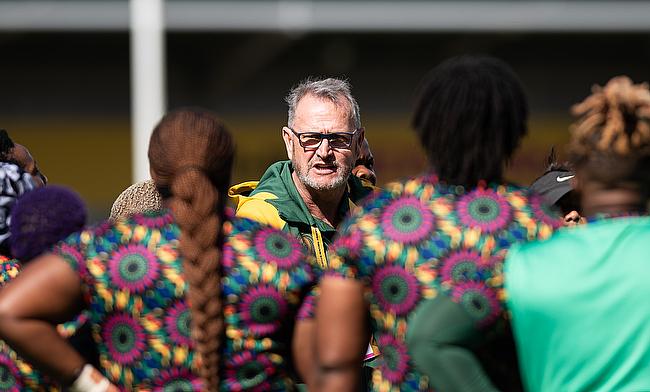
De Bruin guided the Boks to their first ever World Cup quarter-final in 2025
©Lizzy Terry/TEZ.PHOTOG
South Africa and New Zealand will add a new chapter to one of rugby’s great international relationships at FNB Stadium this weekend.
But while the Springbok Women and Black Ferns have each other in their sights, there is another team who continue to loom over the developing landscape of the women’s game: England.
For generations, South Africa against New Zealand has represented one of rugby union’s ultimate measuring sticks.
Springboks against All Blacks. Green against black. World Cups, tours, famous stadiums and some of the greatest players the game has produced.
On Saturday afternoon in Johannesburg, another version of that rivalry begins to take shape.
The Springbok Women face the Black Ferns as part of the Rugby’s Greatest Rivalry double-header, before the men take centre stage later in the afternoon.
Remarkably, it will be the first Test between the women's teams ever played in South Africa and only their third meeting.
But perhaps the most interesting way of looking at Saturday’s game is not simply South Africa versus New Zealand.
Because both countries are chasing somebody else.
And for South Africa, the race has suddenly become more complicated.
The Red Roses have changed the target
For much of the history of women’s rugby, New Zealand represented the ultimate standard.
The Black Ferns have won six World Cups. Their reputation and legacy remain enormous, and the black jersey carries much of the same mystique in the women’s game as it does in the men’s.
But the balance of power has shifted.
England have built an increasingly formidable women’s programme and emerged as the team everyone else must find a way of catching.
That creates a fascinating situation for New Zealand.
They are no longer simply defending their historical position at the top of the sport. They are pursuing the standard now being set elsewhere.
And whilst they sit second in the world rankings behind the Red Roses - who they have lost to in five of their last six meetings - further down in 10th are South Africa.
The Springbok Women are at a very different stage of their development, but their progress over the last couple of seasons means they can increasingly contemplate joining conversations which once appeared a considerable distance away.
That progress, however, has just hit an unexpected bump in the road.
A change at the top
Swys de Bruin was supposed to be part of South Africa’s answer to the question of how quickly the Springbok Women could close the gap.
His appointment brought experience, ambition and a clear belief that the team could eventually compete with the world’s leading nations - as seen at the 2025 Women’s Rugby World Cup, where South Africa progressed to the quarter-final stage of the competition for the first time.
But now their journey will continue without him.
On Thursday, SA Rugby confirmed that De Bruin was stepping down as head coach, with Laurian Johannes-Haupt and Franzel September taking charge as co-head coaches on an interim basis.
The timing is striking.
Only days earlier, the narrative around South Africa was one of acceleration: a team breaking into the world's top ten, testing itself against New Zealand and trying to turn the progress of recent seasons into something more permanent.
Now, before South Africa have even taken to the field against the Black Ferns, the programme has been forced to confront a significant change in direction.
There have been reports in the South African media of a dispute involving De Bruin and SA Rugby. The organisation has, however, indicated that it will not comment further in the short term.
What is certain is that the coach who helped guide South Africa into a new phase of ambition is no longer in charge.
And that makes Saturday's Test even more intriguing.
Remember Exeter
If anyone believes Saturday should be a straightforward Black Ferns victory, it is worth returning to Sandy Park last September.
Yes, De Bruin is no longer at the helm, but South Africa were playing in their first Women’s Rugby World Cup quarter-final.
New Zealand were the defending champions. At half-time, it was 10-10.
And the manner in which South Africa got there was perhaps even more interesting than the scoreline.
They attacked New Zealand with physicality, unconventional forward play and innovation. At one stage, the Black Ferns had been forced to make an extraordinary number of tackles as South Africa repeatedly challenged them around the gain line.
The tactics included 15-player rolling mauls and a seven-one forwards split from the bench; approaches the Black Ferns admitted presented them with something they had not previously encountered.
Eventually class told. New Zealand exploded after half-time, scoring three tries in the opening seven minutes of the second period before going on to win 46-17.
But something had changed.
South Africa had demonstrated that they could disrupt one of women’s rugby’s traditional superpowers.
Babalwa Latsha, who scored against the Black Ferns in Exeter, perhaps summed up the significance best this week when she suggested South Africa are gradually making their way towards the top echelon of the sport and therefore earning more opportunities against teams such as New Zealand.
They have the opportunity this weekend to prove themselves once again against one of the world's leading sides, but of course, will do so without De Bruin in charge.
New Zealand have questions of their own
For the Black Ferns, the questions are different.
South Africa are trying to reach rugby’s top table. New Zealand are trying to make sure they remain at it.
The disappointment of the 2025 World Cup changed the landscape. Having beaten South Africa in the quarter-final, the Black Ferns were eliminated by Canada in the semi-finals.
For a nation accustomed to measuring World Cups in trophies rather than respectable finishes, that mattered.
And England’s rise means New Zealand are now operating in a women’s rugby world which is becoming increasingly competitive.
Canada have demonstrated that they belong among the elite. France remain dangerous. Australia are rebuilding. South Africa might well be on the rise.
The comfortable hierarchy which once existed is becoming much harder to identify.
That is good for women’s rugby.
But it also means every Black Ferns Test carries significance.
The significance of Soweto
Then there is the venue for this Saturday.
FNB Stadium isn’t some secondary ground being used to accommodate the women’s fixture. This is one of the great sporting arenas of Africa.
The Springbok Women kick off at 13:30 local time, with the Springboks and All Blacks following at 17:10.
Thousands of supporters arriving to watch perhaps rugby union’s greatest men’s rivalry will therefore be exposed to its newest equivalent.
That could prove enormously important.
South African women’s rugby doesn’t only need victories. It needs visibility, heroes, supporters and young girls watching players wearing the Springbok jersey on the biggest stages.
De Bruin had described the opportunity to play at FNB Stadium as both an honour and a chance to showcase women’s rugby, while recognising that there remains a considerable gap between the profile of the men’s and women’s teams.
That gap won’t disappear on Saturday, but occasions like this are how it starts to narrow.
And perhaps that makes the timing of his departure all the more poignant.
The Springbok Women are about to step onto one of the biggest stages available to them at precisely the moment their programme has lost the coach who was supposed to help shape its next chapter.
Can another great rivalry emerge?
There is something wonderfully disproportionate about the history involved.
South Africa and New Zealand’s men have spent generations building their rivalry.
Their women’s teams have played each other twice. The first meeting came at the 2010 World Cup. The second didn’t arrive until the 2025 World Cup quarter-final.
Now comes number three - and, crucially, the first in South Africa.
Latsha has already expressed the hope that sharing the 'Greatest Rivalry' occasion with the men’s teams might represent the beginning of something similar for the women.
It is an enticing thought, because rivalries don’t simply come from history. They grow through competitive matches.
South Africa provided enough evidence at Exeter to suggest that, given time and investment, this fixture could become considerably more competitive.
The irony is that South Africa now have to demonstrate that their progress can survive a change in leadership.
All of this makes Saturday at FNB Stadium worth watching well before the Springboks and All Blacks emerge from the tunnel.
The men’s match represents a rivalry almost a century in the making. The women’s match might represent the beginning of another one.
And somewhere, metaphorically at least, the Red Roses will be watching.
But this time, so too will the rest of the rugby world.
South Africa against New Zealand is Saturday’s contest. Catching England remains the bigger race.
But for the Springbok Women, the first step in that race has suddenly become a little more uncertain.