Springboks turn Perth Test into another examination of their extraordinary depth
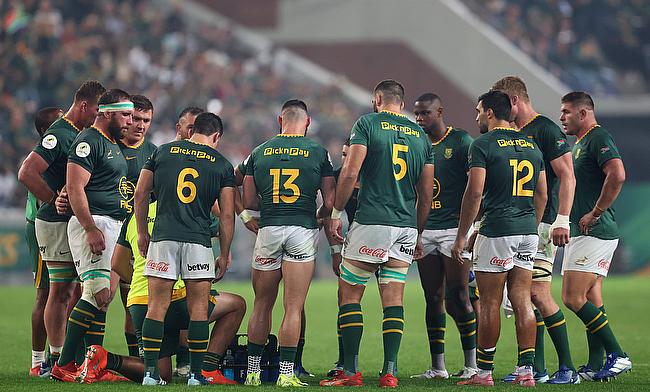
After defeating New Zealand in 'Rugby's Greatest Rivalry', Rassie Erasmus's now head to Australia
©Photo by Steve Haag - Nations Championship/Nations Championship via Getty Images
South Africa’s team to face Australia in Perth may contain 13 changes, a new captain and several players operating outside the Springboks’ established first-choice combination, but nobody should mistake it for a weakened side.
Instead, Rassie Erasmus has turned Sunday’s one-off Test against the Wallabies into another examination of South Africa’s remarkable depth and perhaps his most intriguing experiment yet in positional flexibility.
André Esterhuizen will captain his country for the first time, leading a team which combines the considerable experience of Eben Etzebeth, Franco Mostert and Handré Pollard with players being given an opportunity to strengthen their claims ahead of the 2027 Rugby World Cup.
Only Etzebeth and wing Ethan Hooker retain their starting places from the side which beat New Zealand 43-28 in Baltimore to complete a 3-1 series victory in 'Rugby's Greatest Rivalry'.
It is a dramatic reshuffle, but the spine of the team remains formidable.
Pollard returns at fly-half alongside Herschel Jantjies, while Esterhuizen and Canan Moodie form a powerful centre partnership. Behind them, Aphelele Fassi starts at full-back, with Edwill van der Merwe and Hooker on the wings.
The selection of Esterhuizen as captain is particularly significant.
At 32, he is hardly one of South Africa’s emerging players, but his elevation reflects both the respect he commands and Erasmus’s determination to increase the number of leadership options available to him.
The absence of Siya Kolisi, Pieter-Steph du Toit and Jesse Kriel has created an opportunity to test another captain in a meaningful Test environment. Esterhuizen must now lead a team which has been deliberately constructed to evolve as the match progresses.
That adaptability is most apparent among the forwards.
Jan-Hendrik Wessels starts at loosehead prop alongside Johan Grobbelaar and Zachary Porthen, but Wessels is also capable of moving across to hooker. Marco van Staden, selected at number eight, has previously provided cover in the middle of the front row, while Esterhuizen has become an increasingly credible option at flanker as well as inside centre.
The replacements make the possibilities even more intriguing.
Ox Nche, Malcolm Marx, Wilco Louw, Lood de Jager and Jasper Wiese give South Africa an extraordinarily experienced group of forwards to introduce in the second half.
However, Erasmus has suggested that Marx may not necessarily enter the game at hooker. Wessels could move into the number-two shirt, potentially allowing Marx to be used in the back row.
With Morne van den Berg, Sacha Feinberg-Mngomezulu and Quan Horn completing the bench, South Africa could alter the shape and tempo of their team without being constrained by the numbers printed on the players’ backs.
This is Erasmus exploring a version of total rugby, but it is built upon the Springboks’ traditional physical foundations.
For the Wallabies, the difficulty lies in preparing for several different South African teams.
Australia may initially face the mobility of Wessels, Grobbelaar and Porthen in the front row, the power of Etzebeth and Mostert behind them and the work-rate of Paul de Villiers, Elrigh Louw and Van Staden.
They must then contend with the possibility of Nche, Marx, Louw, De Jager and Wiese arriving together.
The challenge will be a substantial one for Les Kiss’s improving side.
Australia enter the contest unbeaten in five matches, following victories over Italy and Japan and a win and a draw in Argentina. However, facing the world champions immediately after their bruising series victory over New Zealand represents a considerable rise in intensity.
The Wallabies will try to keep the ball alive, stretch South Africa’s heavier forwards and prevent Pollard from controlling territory. Their ability to withstand the Springbok scrum, and then manage the impact of the replacement forwards, could ultimately decide the contest.
There is also a longer-term purpose behind the South African selection.
With the 2027 World Cup being staged in Australia, every Test there provides useful information. Erasmus is learning which players can perform away from home, which combinations can be trusted and which individuals offer genuine positional versatility.
South Africa are no longer simply attempting to build two strong players in every position. They are developing players capable of covering two or even three positions, allowing the coaches to change the balance of the side without making a conventional substitution.
That is what makes this Springbok team so fascinating.
The personnel may be different, but the ambition remains unmistakable: win the Test, extend the squad’s experience and discover another way in which South Africa can make themselves even harder to predict.
For Australia, Sunday represents an opportunity to measure their recent progress against the best side in the world.
For the Springboks, it is another chance to show that rotation, experimentation and winning need not be mutually exclusive.