Forget the obvious combined XV - how good is the team it leaves behind?
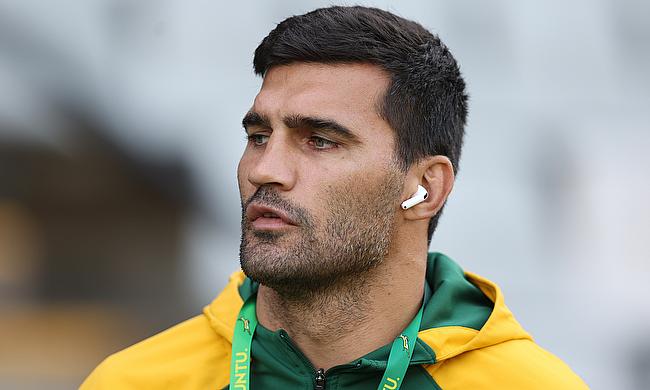
Damian de Allende (in picture) and Quinn Tupaea form a physically imposing centre partnership.
©Nations Championship via Getty
Combined teams have appeared across rugby websites and social media since South Africa completed a 3–1 series victory over New Zealand. TRU accepts one of the most persuasive selections but removes every player from it to discover just how formidable an entirely alternative match-day 23 would be.
Selecting a combined team is one of rugby’s most enjoyable and inevitably contentious post-series traditions. Since South Africa completed their Rugby’s Greatest Rivalry triumph in Baltimore, websites, podcasts and Facebook pages have been choosing the best Springbok-All Black combination from the four Tests.
One of the more persuasive selections was published by The Good, The Bad & The Rugby ANZ. Its team contained 10 Springboks and five All Blacks, an understandable balance after South Africa recovered from losing the opening Test at Ellis Park to win the series 3–1.
Ox Nché, Malcolm Marx and Wilco Louw comprised the front row, with New Zealand’s Fabian Holland partnering Eben Etzebeth at lock. Ardie Savea, Pieter-Steph du Toit and Jasper Wiese formed an extraordinary back row.
Behind the scrum were Cam Roigard and Ruben Love, with Cheslin Kolbe, Jordie Barrett, Jesse Kriel, Will Jordan and Damian McKenzie completing the side.
Arguments could be made in several positions, but every member of that XV produced a legitimate case for inclusion.
Rather than replace one or two names, however, TRU has approached the exercise differently.
What happens if all 15 members of that team are removed from consideration? Can the remaining players who appeared during the series produce another side capable of competing at the highest level? The answer is emphatically yes. We have also selected eight replacements, including a combined version of South Africa’s famous Bomb Squad.
A different but formidable front row
Gerhard Steenekamp starts at loosehead, with Codie Taylor at hooker and Thomas du Toit on the tighthead.
Steenekamp’s presence illustrates the extraordinary depth South Africa possess in the front row. Nché may have been the outstanding loosehead of the series, but replacing him with another powerful Springbok scrummager hardly represents a dramatic reduction in strength.
Taylor captained New Zealand in Baltimore and scored the opening try of the final Test. His accuracy, experience and contribution around the field make him the obvious alternative to Marx.
Du Toit completes the front row. He can operate on either side of the scrum and combines considerable set-piece strength with the mobility and handling ability to influence the game elsewhere.
Ruan Nortje and Tupou Vaa’i form the second row.
Nortje performed much of the less celebrated work that allowed South Africa’s more conspicuous forwards to flourish. He contributed at the lineout, tackled relentlessly and repeatedly put himself into the difficult areas of the contest.
Vaa’i offers athleticism, work rate and positional flexibility. He played at both lock and flanker during the series and provides another high-quality lineout option.
RG Snyman might ordinarily appear in such a team, but he did not play in the series while recovering from injury and is therefore ineligible under our rules.
Kolisi leads a balanced back row
Siya Kolisi captains the alternative side from blindside flanker, with Ethan Blackadder wearing seven and Cameron Hanekom selected at number eight. Leaving Kolisi out of any combined side demonstrates the difficulty of the original exercise. His influence extends far beyond statistics, but he also remains an exceptionally effective Test forward. He returned to lead South Africa after missing the opening Test and immediately helped change the mood and direction of the series.
Blackadder brings relentless defensive work and a willingness to carry into the most congested areas. His try in Baltimore was a reward for another industrious performance and kept New Zealand within reach during the second half. Hanekom provides the final component. His carrying, athleticism and breakdown work give the trio a different profile to Savea, Du Toit and Wiese without making it significantly less threatening. Hanekom’s late try in Baltimore completed South Africa’s victory and provided further evidence that Rassie Erasmus is successfully renewing his squad without sacrificing immediate competitiveness.
Peter Lakai, who is included among the replacements, offers another dynamic back-row option.
Baltimore’s standout controls the tempo
Morné van den Berg starts at scrum-half following his Player-of-the-Match performance in the final Test. Van den Berg’s speed around the breakdown helped South Africa increase the tempo of their attack, while his awareness and support play brought him a try in Baltimore. Roigard was understandably selected in the original combined side, but Van den Berg’s performance in the finale made him impossible to overlook here.
Sacha Feinberg-Mngomezulu takes the number 10 jersey. His capacity to challenge the defensive line, distribute accurately and control territory gives this alternative side an attack capable of playing both directly and expansively.
Richie Mo’unga returned for the Baltimore Test after three years away from international rugby, while Beauden Barrett remains one of the most accomplished players of his generation.
However, this selection rewards contributions across the series rather than reputation alone. Feinberg-Mngomezulu starts, with Barrett providing experienced cover from the bench.
Power, pace and versatility
Damian de Allende and Quinn Tupaea form a physically imposing centre partnership.
De Allende remains one of the finest gain-line centres in Test rugby. His direct running would give Feinberg-Mngomezulu a dependable target, while his defensive understanding would help accommodate a new combination outside him.
Tupaea’s performances offered further encouragement for an All Blacks midfield which continues to evolve. He brings strength, footwork and the capacity to carry through contact at outside centre.
Ethan Hooker and Kurt-Lee Arendse are selected on the wings.
Hooker’s power and directness became increasingly important to South Africa, while Arendse produced one of the defining moments of the final Test. His length-of-the-field score demonstrated the acceleration, anticipation and finishing ability that make him dangerous from almost anywhere.
Damian Willemse completes the starting side at full-back. McKenzie occupies that position in the original XV, but Willemse’s aerial assurance, composure and positional versatility make him an ideal alternative.
TRU’s alternative combined XV
1. Gerhard Steenekamp – South Africa
2. Codie Taylor – New Zealand
3. Thomas du Toit – South Africa
4. Ruan Nortje – South Africa
5. Tupou Vaa’i – New Zealand
6. Siya Kolisi – South Africa, captain
7. Ethan Blackadder – New Zealand
8. Cameron Hanekom – South Africa
9. Morné van den Berg – South Africa
10. Sacha Feinberg-Mngomezulu – South Africa
11. Ethan Hooker – South Africa
12. Damian de Allende – South Africa
13. Quinn Tupaea – New Zealand
14. Kurt-Lee Arendse – South Africa
15. Damian Willemse – South Africa
The alternative Bomb Squad
We have borrowed South African terminology and selected a suitably aggressive 6–2 replacement split:
16. Asafo Aumua – New Zealand
17. Ethan de Groot – New Zealand
18. Fletcher Newell – New Zealand
19. Sam Darry – New Zealand
20. Patrick Tuipulotu – New Zealand
21. Peter Lakai – New Zealand
22. Grant Williams – South Africa
23. Beauden Barrett – New Zealand
Aumua is exactly the type of replacement capable of changing a Test. His explosive carrying provides a different threat to Taylor, while De Groot and Newell complete an entirely New Zealand replacement front row.
Darry and Tuipulotu offer size and fresh lineout options, while Lakai would increase the pace and carrying threat of the back row.
Williams and Barrett provide the flexibility required by a 6–2 formation. Williams can cover scrum-half and wing, while Barrett offers control and creativity at fly-half or full-back.
The versatility already within the starting side also makes the split workable. Willemse and Feinberg-Mngomezulu can cover several backline positions, while Arendse can move between wing and full-back.
The starting XV contains 11 Springboks and four All Blacks, reflecting South Africa’s superiority over the four Tests. The Bomb Squad contains seven New Zealanders and one South African, bringing the complete match-day selection to 12 Springboks and 11 All Blacks.
That balance tells an important part of the tour’s story.
South Africa possessed greater depth within their established Test combinations, particularly through the front row, midfield and outside backs. New Zealand’s eight-match, six-week assignment, however, exposed more players to demanding conditions and revealed another layer of international talent.
Even after selecting 23 players, the list of omissions remains substantial. Handré Pollard, Richie Mo’unga, Wallace Sititi, Luke Jacobson, Anton Lienert-Brown, Canan Moodie and several others could all make legitimate claims.
This alternative side should not really be described as a second XV. It contains a double World Cup-winning captain, proven Test leaders, powerful forwards, elite finishers and Baltimore’s Player of the Match.
The most intriguing question is whether it could beat the widely shared “obvious” team.
That debate may provide the greatest compliment available to Rugby’s Greatest Rivalry. Even after removing the first-choice 15, South Africa and New Zealand can still produce a match-day squad that almost any international coach would happily select.