Sir Billy Boston: A Rugby Giant Who Transcended the Codes
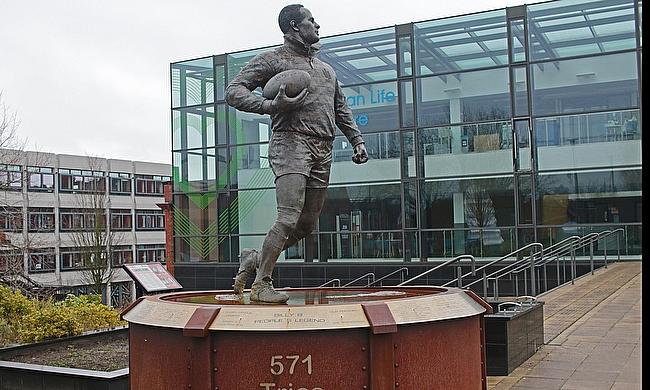
A statue for Sir Billy Boston in Wigan's Believe Square next to Wigan Town Hall.
©Shutterstock
Sir Billy Boston, one of the greatest figures in the history of British rugby, has died at the age of 92.
The temptation for a rugby union website might be to regard that as a story belonging to another code, and that would be a mistake. As I grew up in Lancashire in the 1960s and 1970s, it was Eddie Waring showcasing Rugby League on BBC Grandstand and the occasional trip to Orrell RUFC. It was only in 1983, when I moved to live and work in Wigan, that my understanding of the two codes developed, and I witnessed the importance to the community of Wigan Rugby League and Billy Boston.
I realised that before Billy Boston became a Wigan legend, a Great Britain international, a World Cup winner and eventually rugby league’s first knight, he was a young rugby union player from Cardiff with an extraordinary talent.
His journey from the rugby fields of South Wales to becoming one of the most celebrated sportsmen in northern England tells us something not simply about rugby league, but about rugby. Boston was born in Tiger Bay, Cardiff, in 1934, the son of a Sierra Leonean father and an Irish mother. From what I have learnt, he grew up with rugby union.
He represented Cardiff Schools, Boys Clubs of Wales and Wales Youth, and played for
Cardiff Internationals Athletic Club (CIACs) as well as appearing for Neath and Pontypridd.
But the opportunity his talent surely deserved in Welsh rugby union never fully arrived.
So at 19, his life changed: Boston headed north and signed for Wigan in 1953 for £3,000.
What followed was extraordinary.
He would score 478 tries for Wigan, a club record which still stands, during 15 seasons with the Cherry and Whites. Across his rugby league career he scored 571 tries, a total surpassed only by the great Brian Bevan in the history of the sport. He won three Challenge Cups with Wigan.
In 1954 he became the first non-white player selected for a Great Britain Rugby League
Lions tour, and six years later he was part of the Great Britain side which won the 1960 Rugby League World Cup.
The rugby union question
For those of us whose rugby background is predominantly union, there is another question worth asking today.
What might Billy Boston have achieved had rugby union given him the same opportunity that rugby league did?
It is impossible to answer, but what we do know is that Boston was an exceptional rugby player before he ever arrived at Wigan. Powerful, remarkably quick and possessing the balance and footwork of a much smaller man, he had the characteristics we would recognise immediately in the great wings of either code.
Yet Boston came of age in a very different Britain, and his subsequent career has inevitably led to questions about the opportunities available to Black and mixed-race players in Welsh rugby union during the 1950s. Boston himself wondered why Cardiff RFC never came calling.
Rugby league did, and when it did, it didn’t merely give Billy Boston somewhere to play; it gave him the stage upon which he became a superstar.
Cardiff to Wigan
That journey is an important part of British rugby history. For decades, rugby league clubs looked towards Wales and saw players whose abilities could flourish in the professional game.
Boston became perhaps the greatest of those codebreakers. But there is something particularly powerful about the relationship which developed between this young man from Tiger Bay and the people of Wigan.
He arrived as a teenager and became one of them.
Boston played 15 seasons for Wigan and remained synonymous with the town long after his playing days had finished.
There is a statue of him in Wigan. There is another representation of him outside Wembley, alongside fellow rugby league greats.
Importantly, in 2025, at the age of 90, came recognition that many within the sport felt should have arrived much earlier.
Billy Boston became Sir Billy Boston.
He was the first rugby league player in the 130-year history of the sport to receive a knighthood.
That distinction mattered beyond one man.
For generations, rugby league supporters had watched figures from other sports, including rugby union, receive the highest honours, while some of their own greatest players appeared to be overlooked. Boston’s knighthood therefore felt like recognition both of the individual and of the game he represented.
Today Wigan and rugby league mourns one of its greatest sons.
Rugby should mourn him too.
Sir Billy Boston KBE 1934–2026
Published as a collaboration between TalkingRugbyUnion and Seniormash Reflections on Substack