English Rugby’s Champions Cup reality check: One win, six defeats and some difficult questions
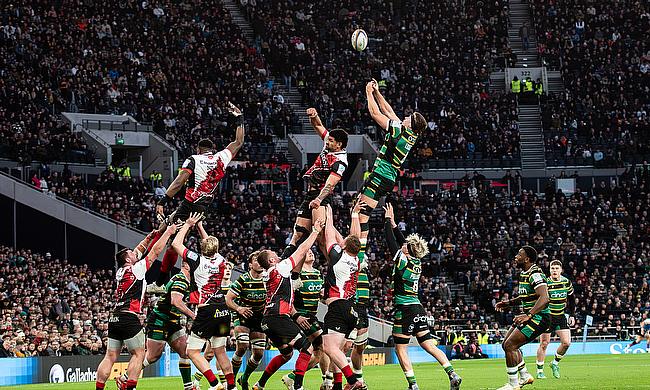
There were contrasting fortunes for Northampton and Saracens in the opening round of the Champions Cup
©Lizzy Terry/TEZ.PHOTOG
For those of us who have followed European club rugby since its earliest days, there has always been a fascination with how English clubs measure up against their French, Irish and, increasingly, South African counterparts.
Last week, writing about the Top 14, I asked a familiar question: which French team would turn up when European competition began? Perhaps I should have been asking a rather different one.
Which English team would turn up?
With the Prem gearing up for 'Derby Weekend' across the course of Friday, Saturday and Sunday, the opening round of the Champions Cup might have become yesterday's news, but it still delivered an uncomfortable answer.
Eight Prem clubs entered the competition, and just one emerged victorious. Northampton Saints beat Cardiff, Gloucester produced a spirited draw against the defending champions Bordeaux-Bègles, and the remaining six English representatives all lost.
One win, one draw and six defeats. Not quite the start English club rugby would have imagined.
A weekend overshadowed
Before the results, a word on the sadness that hung over the weekend.
On Friday, former Sale Sharks lock Hyron Andrews died at the Lions' team hotel in France, on the eve of the South African side's Champions Cup debut at La Rochelle. He was 31.
Andrews made 45 appearances for Sale before returning home to join the Lions this summer. Sale paid tribute to him before Saturday's match against Glasgow Warriors, and director of rugby Alex Sanderson remembered him as "just a brilliant guy and a brilliant teammate."
Glasgow's Franco Smith also sent condolences, and a moment's silence was observed before every Champions Cup and Challenge Cup match.
By grim coincidence, it came 10 years to the day after Munster coach Anthony Foley died in his Paris hotel before a European match against Ronan O'Gara's Racing 92. O'Gara, now at La Rochelle, visited the Lions at their hotel to offer his support.
Rugby results matter, but weekends like this one remind us of their proper place.
Northampton: The exception rather than the rule
Northampton's 28-12 victory over Cardiff at DPD Stadium at Franklin’s Gardens provided the only English success.
Saints handed a European debut to 19-year-old full-back James Pater, who had already scored five tries in five appearances this season, and George Hendy produced the sort of energetic attacking display that has become a Saints hallmark.
The result mattered, but it would be difficult to argue that beating Cardiff at home is a significant statement about the Prem's European strength. Northampton did what good teams are expected to do: they won their home fixture.
Unfortunately, most of their domestic rivals could not say the same.
Phil Dowson's troops return to Prem action this weekend with the small matter of the East Midlands on Saturday afternoon.
Gloucester: Perhaps the most encouraging performance
For me, Gloucester's 36-36 draw with Bordeaux was the most encouraging English performance of the weekend, and it came from the side currently leading the Prem.
The visitors arrived as back-to-back European champions, with Tom Willis already making an enormous impression on his return to French rugby.
Yet Gloucester refused to be intimidated. They led 24-17 at half-time and produced a thrilling contest in which Will Trenholm's two tries briefly threatened a famous victory, before Louis Bielle-Biarrey's double rescued a draw for Bordeaux.
Gloucester demonstrated that the leading French clubs are not invincible. There is, however, an important distinction between competing and winning.
Gloucester did the former exceptionally well. They couldn't quite manage the latter, but what it did do was reinforce the strong start the Cherry and Whites have made to the new season.
Bath: The most worrying result?
Gloucester welcome rivals Bath to Kingsholm on Friday night, with the visitors aiming for a reaction following their 32-14 home defeat to Montpellier.
For me, it was arguably last weekend's biggest disappointment from an English perspective.
Bath were English champions in 2025 and European semi-finalists last season, and they possess international quality throughout their squad. They also led 14-10 at half-time. Yet Montpellier, the Challenge Cup holders and playing their first Champions Cup match in four years, dominated the second half and scored 22 unanswered points.
That is difficult to explain away as an unfortunate evening. The visitors were more effective physically, defended with greater consistency and took their opportunities. Most concerning was the impression that Montpellier grew stronger as the contest went on.
It came only a week after Bath conceded 71 points in a 71-48 defeat at Northampton. For a club with Bath's resources and ambitions, that should prompt some serious reflection ahead of their trip up the M5 to Gloucester.
Sale, Bristol and Saracens: Three different defeats
Sale's 47-27 home defeat to Glasgow Warriors was another worrying result, made heavier by the emotion surrounding the day.
Glasgow arrived with the confidence and organisation we have come to expect from one of the United Rugby Championship's leading sides, scoring freely and exposing defensive weaknesses Sale will need to address.
Bristol Bears suffered an even heavier defeat, losing 49-12 to the Stormers in Cape Town but did rotate and rest ahead of back-to-back Prem games against Exeter Chiefs and Leicester Tigers at Ashton Gate.
Saracens, meanwhile, lost 45-36 at Connacht. There was a time when Saracens were the benchmark for European consistency, combining defensive discipline with an ability to win difficult matches away from home.
Conceding 45 points in Galway suggests the current side has some distance to travel before matching those standards.
Three different opponents and three different sets of circumstances, but a common concern: English clubs conceded far too many points.
Leicester and Exeter: Contrasting disappointments
Leicester's 41-17 defeat at Pau continued the French club's excellent start to the season. We have followed Pau closely in our French coverage, particularly Théo Attissogbe and Portugal international Rodrigo Marta, and they are developing into a formidable attacking side.
Even so, the Tigers have considerable European history, and a 24-point defeat is difficult to reconcile with their ambitions.
Exeter, by contrast, came agonisingly close to the weekend's biggest upset. Back in the Champions Cup after a season in the Challenge Cup, the Chiefs lost 43-40 at Toulouse, despite the French champions playing with 14 men from the 16th minute.
Zack Wimbush scored a hat-trick and Exeter threatened until the closing moments, but Henry Slade's late missed penalty denied them a draw.
There was much to admire in Exeter's ambition and attacking execution, but the conclusion was frustrating. Against 14 men, they scored 40 points and still lost. That says something about Toulouse's extraordinary quality, but it also raises questions about Exeter's ability to control matches when the opportunity presents itself.
Is the Prem falling behind?
One weekend does not establish a long-term trend, and it would be unfair to draw sweeping conclusions from eight matches. Nevertheless, there are structural questions that deserve examination.
The Prem operates under financial restrictions designed to encourage sustainability and competitive balance, while French clubs benefit from larger budgets, substantial commercial revenues and, in many cases, greater squad depth.
The United Rugby Championship presents a different challenge, with leading Irish, Welsh, Scottish and South African sides regularly exposing English teams to contrasting styles of play.
There is also the question of qualification. With only 10 clubs in the Prem, eight qualify for the Champions Cup. Only Harlequins and Newcastle missed out this season, which makes English participation relatively widespread compared with the intensity of qualification in France.
Does that dilute the quality of England's representatives? And does domestic rugby adequately prepare English clubs for the physical demands of Europe?
These are questions worth asking rather than assuming the answers.
The defensive problem
What struck me most about the weekend was not simply the number of English defeats, but the number of points conceded. Sale allowed 47, Bristol 49, Saracens 45, Exeter 43 and Leicester 41. Bath conceded 32 at home, and even Gloucester, in their excellent draw, let in 36.
Across the eight matches, English clubs conceded 305 points, an average of more than 38 per game.
There is clearly attacking talent throughout the Prem, and we will undoubtedly see that across 'Derby Weekend'.
But European rugby remains unforgiving when defensive organisation, discipline or physical intensity falls short. English clubs cannot expect to beat Europe's strongest sides regularly if they keep conceding five or six tries.
Where does English rugby go from here?
The encouraging news is that the Champions Cup has only just begun. Northampton have points on the board, Gloucester showed genuine competitiveness against the champions, and Exeter proved that Toulouse can be troubled. There is still plenty of rugby to play.
But English clubs need more than spirited performances and narrow defeats; they need victories. For all the legitimate discussion about salary caps, squad sizes and financial sustainability, European competition provides a relatively straightforward measure of progress.
Can English clubs beat the strongest teams from France, Wales, Ireland, Scotland and South Africa?
On the evidence of the opening weekend, not often enough.
Last week, I wondered which French teams would turn up in Europe. After watching the English results unfold, perhaps the more important question is this: are Prem clubs still equipped to compete consistently with Europe's best?
Round Two in December will provide another opportunity to answer it. English rugby badly needs that answer to be more encouraging.
As a spectator, I am loving the attack we are seeing from the English sides, but I still like the old-fashioned W.