The PREM. The CHAMP. The NLR? A Branding Thought for Rugby's Third Tier
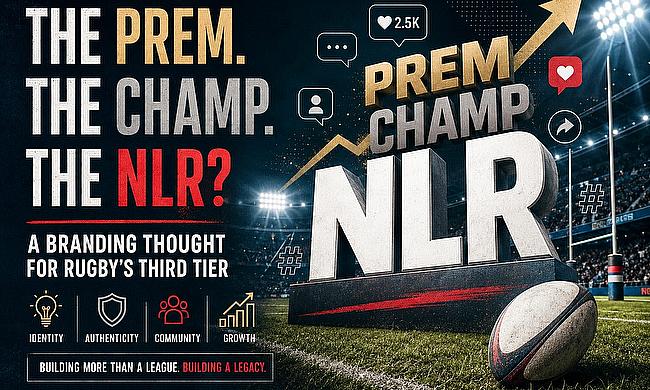
National League Rugby’s growing use of “NLR” shows how supporter language, social habits and organic engagement may be shaping rugby’s third-tier identity.
I’ve noticed something interesting. People inside the game increasingly say NLR rather than National League Rugby. That may tell us something.
I’ve been following the NLR website and app, watching how users engage, and following social media habits and one particular detail keeps recurring: this shorthand turning up unprompted, in meetings and WhatsApp threads, more often than the full name does. On Facebook and Instagram, the NLR is seeing unprecedented growth in engagement and followers; all without paid promotion – best described as organic.
Nobody announced it. Nobody voted on it. It’s simply what people say now, without thinking about it.
NLR.
At first, I dismissed it as shorthand. Busy people compress busy phrases. Nothing more to read into it than that. Now I am not so sure, because branding in sport is changing fast, and it is changing from the bottom up as much as the top down. Premiership Rugby has become the PREM. Not through a rebrand launched with fanfare and a new logo, but through repetition. Broadcasters said it. Players said it. Fans said it. Eventually the competition itself leaned in and said it too. The Championship is going through something similar, quietly becoming the CHAMP in commentary boxes and social captions, even where the official title still reads in full.
That made me wonder.
Is rugby’s third tier already evolving its identity without fully realising it?
Language usually leads, branding usually follows
There is a pattern here worth paying attention to. In my experience across four decades in commercial roles, the language people use casually is often the most honest research you will ever get, because nobody is trying to please a focus group when they type “NLR” into a WhatsApp thread. They are just being efficient.
Brands that listen to that efficiency and shape themselves around it tend to feel authentic.
Brands that ignore it and insist on the full formal title tend to feel like they are speaking a different language to their own audience.
The PREM did not decide to become the PREM. Its people decided for it, and the competition was smart enough to notice and follow.
This has happened before, in this very competition
And here is the thing. This would not even be the first time.
For many years, this level of the game was the NCA Competition, and the leagues within it were known, in the stands and on social media, as #Nat1 and #Nat2, with #Nat2N and #Nat2W for the regional splits.
Nobody sat in a branding meeting and decided that supporters should shorten “National Division One” to “Nat1.” It just happened, the way NLR is happening now, because a hashtag with fewer characters travels further and a shorthand that fits a tweet gets used more than one that does not.
So this is not a new phenomenon for the competition to navigate. It is a repeat of a pattern the competition has already lived through once, under a different name, in a different era of social media. The only real question is whether the lesson from #Nat1 and #Nat2 gets applied this time, or whether it takes another rebrand and another decade before anyone notices the shorthand was there all along.
Why this matters more for the third tier, not less
It would be easy to think a shorthand nickname matters more for competitions with big broadcast deals and national profile, and less for a competition still building recognition. I would argue the opposite.
A competition fighting for attention needs every advantage it can get, and a short, sayable, shareable name is a real advantage. Three letters fit a shirt sleeve, a hashtag, an app icon and a radio mention in a way that four words never will. If clubs, players and supporters are already calling it NLR without being asked, the competition is being handed a piece of brand equity for free.
The question is whether to notice it and build on it or let it happen by accident and arrive at the identity a few years late, after someone else has already claimed the space.
A thought, not a verdict
I do not run National League Rugby, and I am not about to tell anyone how to run it, but I have spent a career watching how organisations either shape their own language or get shaped by it, and the pattern rarely reverses itself once shorthand takes hold.
People are already saying NLR. The interesting decision is not whether that happens. It already has. The interesting decision is what the competition chooses to do about it.