Springboks v All Blacks - Rassie v Rennie - Two Different Visions for Rugby’s Greatest Rivalry
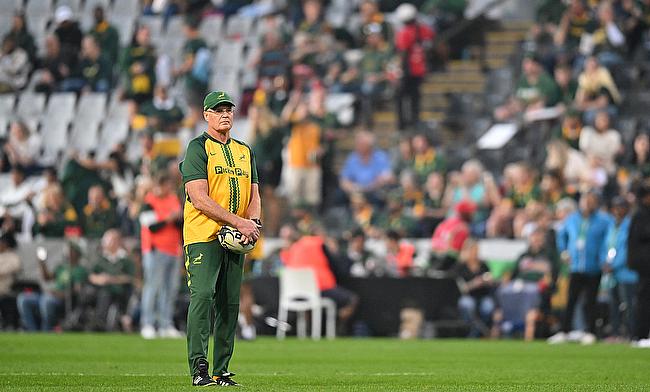
Rassie Erasmus' South Africa have evolved and they are not simply a side whose ambition is squeeze opponents through set-piece dominance and territorial pressure
©Nations Championship via Getty Images
There are international rugby matches, there are rivalries, and then there is South Africa against New Zealand.
On Saturday, Ellis Park stages the first Test of the much-hyped 'Rugby’s Greatest Rivalry' series, and if the team sheets are anything to go by, Rassie Erasmus and Dave Rennie have arrived at the same contest with two rather different ideas about how it might be won.
South Africa have selected a side built around power, experience and their now familiar ability to change the physical complexion of a Test from the bench. New Zealand appear to be betting more heavily on pace, mobility and attacking ambition.
It makes the opening Test intriguing before a ball has even been kicked.
Rassie goes big, but not entirely predictable
There are plenty of familiar names in the Springbok XV. Ox Nche, Malcolm Marx and Wilco Louw form a formidable front row.
Eben Etzebeth and Ruan Nortje provide the second-row muscle, while Jasper Wiese anchors a back row containing Pieter-Steph du Toit and the rapidly emerging Paul de Villiers. With Siya Kolisi unavailable after his hamstring problem, du Toit captains the side.
Perhaps the most interesting forward selection is De Villiers. Still only 23, the Stormers flanker has been one of the players to emerge from Erasmus’s continued determination to expand South Africa’s playing depth. Putting him into a Test of this magnitude, alongside du Toit and Wiese, is another indication that the Springboks are not simply protecting their established generation as the 2027 World Cup approaches.
They are developing the next one while continuing to win. There is also a significant call at tighthead. Louw starts, while Thomas du Toit is omitted from the matchday 23 altogether, with Zachary Porthen providing replacement cover.
That hardly suggests Erasmus is short of options.
Sacha gets the keys
The selection that could shape the way South Africa play comes at fly-half.
Sacha Feinberg-Mngomezulu starts at 10.
Erasmus could have gone for Manie Libbok, who instead sits on the bench, but has entrusted Feinberg-Mngomezulu with directing the Springboks against the All Blacks.
Alongside the rapid Grant Williams at scrum-half, it gives South Africa a half-back combination capable of playing at considerable tempo.
For all the discussion about Springbok power, this is no longer a South African side whose ambition is simply to squeeze opponents through set-piece dominance and territorial pressure.
Outside Feinberg-Mngomezulu sit Damian de Allende and Jesse Kriel, with Kurt-Lee Arendse, Cheslin Kolbe and Damian Willemse continuing to form a dangerous back three.
There is attacking ability everywhere, and on Saturday this will be particularly significant for De Allende, who reaches 100 Test caps.
It is quite an achievement for a player who has become one of the defining Springbok backs of this era: physically imposing, defensively reliable and an important link between South Africa’s power game and the space available outside him.
Then comes the Springbok bench...
Perhaps the biggest difference between the two team sheets can be found among the replacements. South Africa go 6-2.
Jan-Hendrik Wessels, Gerhard Steenekamp, Zachary Porthen, Cobus Wiese, Andre Esterhuizen and Marco van Staden provide the forward options, with Cobus Reinach and Libbok covering the backs.
It is another version of the Springbok philosophy which has caused opponents so many problems. Survive the starting pack and another wave arrives.
But there is a little more subtlety to this particular bench. Esterhuizen’s ability to operate both as a centre and as a hybrid forward gives Erasmus considerable flexibility.
If this Test is still level after an hour, the replacements could become hugely significant.
Rennie chooses a different route
New Zealand’s response is fascinating because Dave Rennie has resisted the temptation simply to try to match South Africa kilogram for kilogram. His All Blacks bench is a conventional 5-3 split.
The starting pack is Ethan de Groot, Codie Taylor and Tyrel Lomax in the front row, Josh Lord and Fabian Holland at lock, and a back row of Tupou Vaa’i, Luke Jacobson and captain Ardie Savea.
Holland’s selection is particularly interesting.
Having missed the Super Rugby Pacific season and the Nations Championship through injury, he has returned impressively on this tour and replaces Patrick Tuipulotu.
Vaa’i continuing at six also gives the All Blacks size without sacrificing the athleticism Rennie appears to want from his pack, but there is little doubt what is waiting for them.
Nche, Marx, Louw, Etzebeth, Wiese and du Toit will test New Zealand’s ability to generate quick ball while simultaneously trying to deny them exactly that. The breakdown could be ferocious.
Roigard returns and Love gets his biggest examination
New Zealand have received a major boost with Cam Roigard and Will Jordan both passed fit. Neither has played in the three franchise matches on tour, but both go straight into the starting XV.
Roigard partners Ruben Love at half-back, and Love’s selection creates one of the most interesting individual comparisons of the Test.
Feinberg-Mngomezulu vs Love.
Two talented playmakers being asked to run their countries’ attacks in perhaps the most physically demanding fixture in world rugby.
Love will have Jordie Barrett and Quinn Tupaea immediately outside him, with Josh Moorby retaining the left-wing position after his two tries against the Bulls. Jordan starts on the opposite wing and Damian McKenzie, recovered from an ankle problem, is at full-back.
That backline tells us something about what Rennie wants.
Speed and movement combined with optionality.
And the ability to attack South Africa from positions where the Springboks might ordinarily expect an opponent to kick.
The curious absence of Beauden Barrett
One of the biggest names missing from the matchday 23 is Beauden Barrett. Richie Mo’unga has only recently rejoined the All Blacks environment and was never expected to be rushed into the opening Test, but Barrett’s omission means Rennie has made a clear commitment to Love.
There is no experienced former World Player of the Year sitting on the bench if the Test begins to unravel. That is quite a statement of confidence in the younger fly-half.
New Zealand’s replacement backs are Kyle Preston, Anton Lienert-Brown and Leroy Carter.
The message appears fairly clear: the All Blacks are not planning merely to hang around and hope South Africa make mistakes. They intend to play.
Don’t read too much into the warm-ups
The tourists certainly arrive with momentum.
New Zealand have beaten the Stormers 38-21, the Sharks 54-0 and the Bulls 50-19 in their three warm-up fixtures.
The performance against the Bulls was particularly impressive, with eight tries and signs that Rennie’s attacking philosophy is beginning to take shape.
But Ellis Park against the Springboks is an entirely different proposition.
Rennie himself acknowledged that the Test series represents a significant step up from the tour matches. South Africa remain the world’s benchmark Test side, while Ellis Park has become one of rugby’s most intimidating stages.
The first 20 minutes could tell us plenty
There is an obvious assumption that South Africa will want to slow New Zealand down.
That may be too simplistic. Erasmus has already pushed back against the suggestion that the Springboks need a slow game to beat the All Blacks - and with Williams, Feinberg-Mngomezulu, Kolbe, Arendse and Willemse on the field, South Africa possess enough pace and creativity to attack themselves.
The more interesting question is who controls the speed of the contest.
If Roigard can generate fast ball and Love can bring Jodie Barrett, Jordan and McKenzie into the game, New Zealand can stretch the Springbok defence.
If South Africa dominate the collisions, slow the breakdown and start winning scrum penalties, the Test could move rapidly in the opposite direction.
And hovering over everything is the altitude of Johannesburg.
Ellis Park is not a venue where you want to spend long periods defending against either of these sides.
Watch the final quarter
For all the attention on Feinberg-Mngomezulu, Love, Kolbe, Jordan and the other attacking players, this match may ultimately be decided by something much less glamorous.
The respective benches.
South Africa’s six-forward replacement strategy is designed to maintain - and ideally increase - their physical pressure.
New Zealand’s 5-3 configuration gives Rennie greater backline flexibility and perhaps tells us he wants his team capable of attacking late rather than simply surviving.
It creates the possibility of two very different final-quarter strategies.
South Africa may look at minute 60 and think: more power. New Zealand may look at the same scoreboard and think: more space.
Whichever philosophy prevails could tell us a great deal about the remaining three Tests.
TRU View
Perhaps the most exciting thing about Saturday is that neither team sheet feels conservative.
South Africa could have picked a side simply designed to overpower New Zealand. Instead they have given Feinberg-Mngomezulu the 10 shirt and surrounded him with attacking threats.
New Zealand could have responded to the Springbok pack by loading their own bench with forwards. Instead, Rennie has retained a 5-3 split and backed Love, Roigard and an adventurous back three.
There will inevitably be scrums, mauls, aerial contests and a brutal battle at the breakdown, but there might also be considerably more rugby played than some expect.
And after all the marketing around 'Rugby’s Greatest Rivalry', that might be exactly what this series needs.
Four Tests. The world’s two great rugby nations. Two contrasting philosophies.
Ellis Park is where we find out which one lands the first blow.
South Africa: 1 Ox Nche, 2 Malcolm Marx, 3 Wilco Louw; 4 Eben Etzebeth, 5 Ruan Nortje; 6 Paul de Villiers, 7 Pieter-Steph du Toit (capt), 8 Jasper Wiese; 9 Grant Williams, 10 Sacha Feinberg-Mngomezulu; 11 Kurt-Lee Arendse, 12 Damian de Allende, 13 Jesse Kriel, 14 Cheslin Kolbe; 15 Damian Willemse.
Replacements: 16 Jan-Hendrik Wessels, 17 Gehard Steenekamp, 18 Zachary Porthen, 19 Cobus Wiese, 20 Andre Esterhuizen, 21 Marco van Staden; 22 Cobus Reinach, 23 Manie Libbok.
New Zealand: 1 Ethan de Groot, 2 Codie Taylor, 3 Tyrel Lomax; 4 Josh Lord, 5 Fabian Holland; 6 Tupou Vaa’i, 7 Luke Jacobson, 8 Ardie Savea (capt); 9 Cam Roigard, 10 Ruben Love; 11 Josh Moorby, 12 Jordie Barrett, 13 Quinn Tupaea, 14 Will Jordan; 15 Damian McKenzie.
Replacements: 16 Asafo Aumua, 17 George Bower, 18 Fletcher Newell, 19 Anton Segner, 20 Peter Lakai; 21 Kyle Preston, 22 Anton Lienert-Brown, 23 Leroy Carter.