Rugby's American Gamble Just Paid Off. Can It Last?
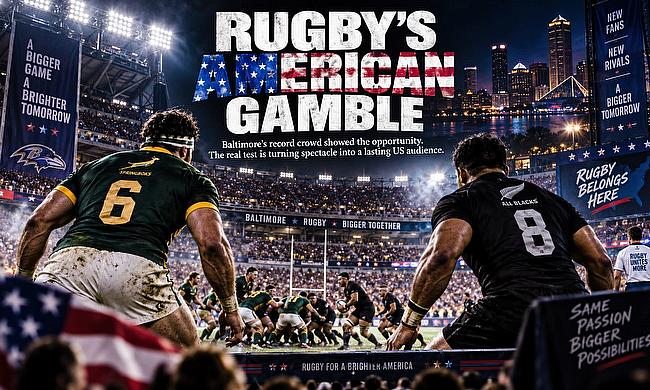
A record 68,000-plus crowd in Baltimore offered a glimpse of rugby’s potential in America
Baltimore has never seen anything quite like it. On September 12, more than 68,000 people filled M&T Bank Stadium, home turf for the NFL's Ravens, to watch South Africa beat New Zealand in the final Test of "Rugby's Greatest Rivalry." It was the biggest crowd for a rugby match in North American history, eclipsing the 62,000 who packed Chicago's Soldier Field for an All Blacks win over Ireland back in 2016.
The numbers alone tell a story. Ticket sales topped 62,300 before kickoff. Both unions reportedly stood to make around $8 million more by staging the game in America than they would have back home. Nike and Coca-Cola, sponsors of the Springboks, see the US as commercially essential and none of that happens by accident; it happens because rugby has a five-year deadline.
A NINE-YEAR RUNWAY
Rugby sevens returns to the Olympic stage in Los Angeles in 2028. Three years after that, the men's Rugby World Cup arrives in the US for the first time, a tournament of that scale has never once been staged there, with the women's World Cup following in 2033. Between them, the two events give the sport nine years to convert curiosity into a genuine domestic following, and World Rugby has treated that stretch as a single, connected campaign rather than two separate dates on a calendar. Baltimore was one more rehearsal for it.
"The US is an important market for us and for rugby more broadly, as we look ahead to Rugby World Cup 2031," interim New Zealand Rugby chief executive Steve Lancaster said before kickoff. It was the All Blacks' fourth US appearance in five years, Chicago, Washington, San Diego, now Baltimore. Nowhere gets picked twice by accident either.
Michael Goldman, a sport management professor at the University of San Francisco, expects crowds like Baltimore's to keep skewing toward two overlapping groups: an expatriate community, SA Rugby estimates 150,000 to 180,000 South Africans live in the US and a homegrown rugby population that keeps expanding underneath them. "We've seen growth at college level, in sevens, and now with Major League Rugby," Goldman said. "There's certainly a lot of interest."
THE NUMBERS UNDERNEATH THE OCCASION
Strip away the one-off spectacle and the underlying data is where the real argument for
American rugby sits. Youth and high school registrations passed 50,000 in 2024, up 12 percent year-on-year, with the 8–14 age bracket growing faster still. Major League Rugby, now nine seasons old, fields rosters that are more than 84 percent domestic players; proof, if nothing else, that there's somewhere for those juniors to go.
Set the US total of around 132,000 registered players against an estimated 1.5 million who play some form of the game casually or at school, and you get the largest gap between "registered" and "playing" of any major rugby nation. That gap is either a marketing failure or the single biggest growth opportunity left in the sport, depending on who you ask.
Ilona Maher would probably say the latter. Her bronze-medal run with the US sevens team at the Paris Olympics, and the social-media following that came with it, did more to introduce rugby to people who had never watched a ruck in their lives than a decade of Test matches managed on its own. Body positivity, personality, a genuine American star; that combination doesn't come along often in a niche sport, and rugby's administrators know it.
Will Hooley has lived both halves of that equation. The Cambridge-born fly-half came through Northampton, Exeter and Saracens before switching allegiance to the USA Eagles and signing for San Diego Legion in 2021. He retired in 2023 and moved straight into the game's broadcast side, and this season he's fronting MLR's "Sunday Night Rugby" on ESPN. Writing recently about his own path into the American game, Hooley pointed to the same crowded 2026 calendar driving this piece; a fresh MLR season, the Baltimore Test, LA 2028 on the horizon, as evidence that there's plenty for a home audience to get excited about, if the sport can hold their attention long enough to notice.
STILL A CROWDED HOUSE
None of this erases the obstacle sitting in the middle of the room: the NFL. American football's grip on the domestic sports calendar, its broadcast deals and its sponsorship dollars remains close to total. Rugby's rules are unfamiliar to most Americans, its season overlaps with sports that already have their loyalty, and a sold-out one-off Test doesn't automatically become a habit.
Bob Dorfman, a San Francisco-based sports marketing analyst, has made that case before: a reliable sponsorship pipeline and regular television exposure matter more than any single showcase event, however large the crowd. Persuading millions of already-committed fans to make room for one more game is a slower job than filling a stadium for a weekend.
Baltimore was never going to answer that question by itself. What it did was buy rugby five more years of momentum, and a very large receipt to show for it. Whether 2031 finds a sport that has built a genuine American audience, or one that simply borrowed a stadium for an afternoon, is still very much up for grabs.