Knee-drop, hip-drop and the growing debate over rugby's new tackle laws
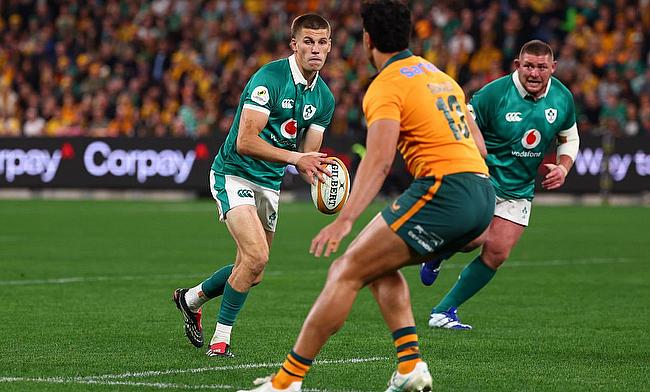
Sam Prendergast has been cleared to face South Africa after his hip-drop tackle against Fiji was not deemed worthy of a red card
©Photo by Morgan Hancock - Nations Championship/Nations Championship via Getty Images
Two different tackling terms have become a major talking point in international rugby this November, with contrasting disciplinary decisions raising questions about player safety and the consistency of officiating.
What started as a debate over knee-drop and hip-drop tackles has since developed into a much wider story, with South Africa head coach Rassie Erasmus receiving a six-match suspension following his criticism of match officials.
Although the two techniques have similarities, they involve different movements and carry different risks. Recent incidents involving Australia, Ireland, France and South Africa have brought both into the spotlight.
Understanding the difference
A knee-drop tackle is when a defender drops a knee to the ground before making contact with the ball-carrier. World Rugby’s guidance, effective from 5 October, says that this takes the tackler off their feet.
Under Law 13, a player on the ground in open play cannot tackle or attempt to tackle an opponent. If the action is reckless or dangerous, foul-play laws may also apply.
The concern is partly about the position it puts both players in. The defender’s head can be lowered to the height of the carrier’s knees, while contact from so low down can cause the carrier to flip or land awkwardly.
World Rugby says a defender who happens to make contact with the ground as they tackle is not automatically committing foul play, provided the action is not dangerous. The detail of the movement matters.
The hip-drop law change took effect on 1 November. World Rugby’s guidance says a tackle with minimal contact to the lower limbs can be penalised. Where there is more substantial contact, a yellow or red card may be considered, depending on the level of danger and the circumstances.
Angus Bell's yellow card brings the new guidance into focus
One of the early examples of the revised hip-drop guidance being applied came during Australia's match against England on 8 November.
Wallabies prop Angus Bell was yellow-carded for a hip-drop tackle on Immanuel Feyi-Waboso, who was injured and later left the match.
In this tackle, the defender grasps the carrier from the side or behind, swings around or through them, and drops their hips or bodyweight onto the carrier’s lower limbs. Bell’s yellow card remained a yellow after review.
The distinction is useful for supporters: Bell was not shown a card for dropping to a knee before tackling. His sanction concerned the swinging movement and weight coming down onto Feyi-Waboso’s lower limbs
Erasmus challenges France's tackling technique
The debate intensified following South Africa's narrow 21-19 defeat against France in Paris on 13 November.
Springboks head coach Erasmus claimed France had made 17 knee-drop tackles that went unpunished. He said he believed 11 warranted penalties and three should have resulted in yellow cards. Those are Erasmus’s assessments; the number and severity of the incidents have not been independently established here.
His criticism also raises a question about the TMO’s role. World Rugby’s November guidance says TMO input on knee-drop tackles is required when there is a dangerous outcome; for example, if a player lands on their head or flips over.
That does not mean every knee touching the ground must prompt a video review; the referee can still penalise an infringement under the laws.
The distinction is important because the aim is to improve player safety without turning every tackle into a lengthy video review.
Prendergast cleared to play v South Africa
Another incident brought the hip-drop law under scrutiny following Ireland's victory over Fiji on 14 November.
Fly-half Sam Prendergast was subsequently cited for a tackle on Fiji flanker Peceli Yato. During the challenge, Prendergast wrapped himself around the back of Yato's legs, raising concerns about the technique under the revised regulations.
No penalty or card was issued during the match, but the incident was referred for retrospective disciplinary consideration.
Prendergast was ultimately cleared by a panel, which decided that the tackle did not meet the threshold for a red-card sanction. He is therefore available for Ireland's meeting with South Africa on Saturday.
The outcome attracted attention after Erasmus said the Ireland 10 would escape punishment because of a technicality.
Regardless, the difference in outcomes has added another layer to the debate about how the new guidance is being interpreted.
How consistently can officials apply new or newly emphasised guidance in a fast game?
World Rugby says the measures are intended to reduce injury risk. The coming weeks will show how clearly players adapt their technique and how consistently referees and TMOs identify the actions the guidance is designed to address.
But it is safe to say rugby's new tackle regulations have faced some early scrutiny.