When the Drama Starts Before Kick-Off: Airlink, the Springboks and a Flypast That Evoked 1995
The sight of two Airlink aircraft sweeping extraordinarily low over DHL Stadium before South Africa faced New Zealand provided one of the images of the series. But for anyone who remembers Ellis Park in 1995, it also carried unmistakable echoes of one of rugby’s most famous afternoons.
There are occasions in sport when the moment you remember happens before the game has even started.
Cape Town provided one of them last Saturday.
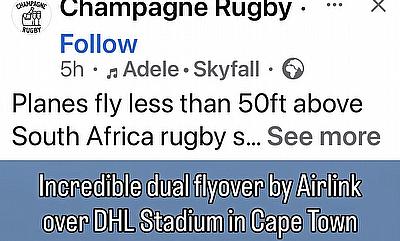
With DHL Stadium full and South Africa and New Zealand preparing for the second Test of Rugby’s Greatest Rivalry, two Airlink Embraer aircraft appeared above the ground.
One carried Springbok colours. The other represented the All Blacks.
And they were low. Very low.
From inside the stadium, the sight was spectacular. On television and social media, it looked almost unbelievable.
Flight-tracking analysis subsequently estimated that the lead aircraft may have cleared the stadium roof by only around 12.5 to 14 metres that is roughly 41 to 46 feet.
For a few seconds, rugby took second place.
Planned, rehearsed – and spectacular
Inevitably, the flypast prompted questions.
Airlink subsequently stressed that this wasn’t an improvised piece of showmanship. The airline said the operation had been carefully planned and rehearsed, undertaken with the necessary aviation approvals and flown by experienced crews.
Three senior captains were reportedly aboard each aircraft, while the operation involved coordination with the South African Civil Aviation Authority and Air Traffic and Navigation Services.
That context is important.
Watching from the ground, however, none of that diminished the extraordinary visual impact.
A modern passenger jet passing immediately above a packed sporting stadium is unusual enough.
Two of them, immediately before a Springboks-All Blacks Test, inevitably created something memorable.
But there was another dimension to the moment.
For rugby supporters of a certain age, it was almost impossible to watch without thinking of Ellis Park, 24 June 1995.
“Good Luck Bokke”
That afternoon has become embedded in rugby history.
South Africa were hosting New Zealand in the Rugby World Cup final.
Nelson Mandela appeared wearing Francois Pienaar’s number six Springbok jersey.
And shortly before the match, spectators at Ellis Park witnessed something extraordinary overhead.
A South African Airways Boeing 747 approached the stadium at low altitude, captained by Laurie Kay.
On its underside was a message:
GOOD LUCK BOKKE.
The enormous aircraft swept over Ellis Park, producing an image which became inseparable from the mythology surrounding that World Cup final.
What followed only intensified it.
South Africa and New Zealand fought out one of rugby’s most famous finals before Joel Stransky’s extra-time drop goal secured a 15–12 Springbok victory.
Mandela presented the Webb Ellis Cup to Pienaar. The images travelled around the world with the aircraft became part of the story.
Thirty-one years later
There are obvious differences between 1995 and 2026.
This was Cape Town rather than Ellis Park.
These were Embraers rather than a Boeing 747.
It was a Test series rather than a World Cup final, and nobody should pretend that the political and social significance surrounding South African rugby in 1995 can simply be recreated three decades later.
But the rugby connection was unmistakable.
Once again, it was South Africa against New Zealand.
Once again, aircraft appeared dramatically above a packed South African stadium.
And once again, the flypast became part of the theatre surrounding one of international rugby’s great rivalries.
Perhaps appropriately, the Springboks then produced a performance worthy of the occasion.
Having lost 33–16 at Ellis Park seven days earlier, South Africa responded in Cape Town to win 33–26, levelling the four-Test series at 1–1.
How far should sporting theatre go?
There is, however, another side to the story.
The reaction online demonstrated that not everybody regarded the flypast simply as spectacular entertainment.
Some observers were uncomfortable with its apparent altitude.
That is a reasonable discussion to have.
Modern sport increasingly searches for bigger entrances, bigger visuals and bigger moments. Fireworks, light shows, aircraft and elaborate pre-match productions have become part of presenting major events.
The challenge is ensuring spectacle never becomes more important than safety.
Airlink has been clear that the Cape Town operation was planned, approved and professionally executed.
The images nevertheless demonstrate why it generated such discussion.
It looked daring because it was daring.
And perhaps that is why people are still talking about it.
More than a flypast
For me, though, the most interesting part was the historical echo.
Thirty-one years separate Ellis Park in 1995 from Cape Town in 2026.
Rugby has changed enormously. South Africa has changed enormously. The aircraft have certainly changed but the opponents haven’t.
Springboks against All Blacks remains one of those sporting contests capable of producing an atmosphere that reaches far beyond 80 minutes of rugby.
The Cape Town flypast captured that perfectly.
Two aircraft with two great rugby nations and a packed stadium looking skywards.
A reminder that when South Africa play New Zealand, sometimes the drama begins before anyone has even touched the ball.