Valencia to Calais: A Rugby Road Trip
Four days, roughly 1,700km, and a route that happens to cut straight through some of the richest rugby soil in Europe; both codes of it. What started as a simple Valencia-to-Calais dash for the ferry turned, once I looked properly at the map, into something closer to a pilgrimage. This is the itinerary, and the clubs and grounds worth slowing down for.
Day 1: Valencia to Barcelona (~350km)
Spanish rugby doesn’t get the column inches it deserves, but Barcelona is as good a place as any to start making the case. UE Santboiana, out in Sant Boi just south of the city, is Spain’s oldest club; founded in 1921 and still the standard-bearer for Catalan rugby. FC Barcelona itself now fields a rugby section too, a reminder that even in the most footballobsessed city on earth, the oval ball has a foothold. A gentle opener, more scene-setting than shrine-visiting, before the real business starts tomorrow.
Day 2: Barcelona to Perpignan (~200km)
This is where the trip earns its keep, because Perpignan is a genuine two-code city and both halves are worth your time.
US Perpignan (union) had a nervy end to last season, they had to win the Top 14 access match against Provence Rugby in June just to stay in the top flight, a fixture French rugby now calls the Access Match, and it’s the fourth time in recent years Perpignan have had to survive it that way. Their ground, Stade Aimé Giral, is one of the great atmospheres in French rugby; tight, loud, unmistakably Catalan.
A few minutes across town is Stade Gilbert Brutus, home of the Catalans Dragons, the French club playing in England’s Super League, and the first non-British side ever to win the Challenge Cup, beating Warrington at Wembley in 2018. Named after a Perpignan rugby captain who was murdered by the Gestapo in 1944 for his Resistance work, it’s a ground with real weight behind the name. Worth timing a stop around, if the schedule allows.
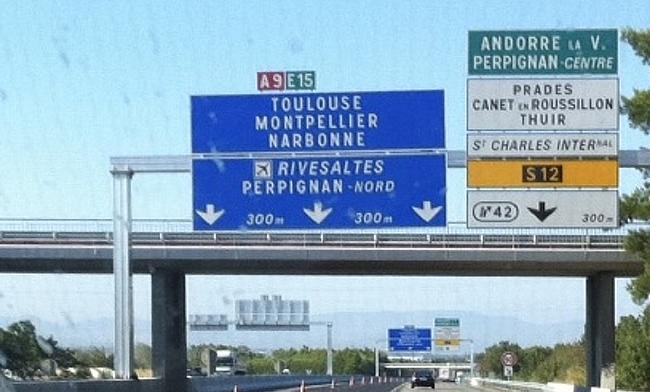
I’ve come off that A9 exit before;the big blue gantry hits you with Toulouse, Montpellier and Narbonne all at once, Perpignan-Nord peeling off 300 metres later, and it’s a genuinely handy staging post for this stretch of coast. Last time through I stayed just south of the city in Saleilles, at the Hôtel Les Domes, and ate at Chez Christopher, an easy-to-find spot on the roundabout circuit just off the Argelès road. Nothing fancy, but a solid, no-nonsense base if you want to split the Perpignan double-header, union in the afternoon, league under the lights, without doing it all in one mad dash.
Day 3: Perpignan to Béziers, via Narbonne, Carcassonne and Montauban (~340km with the detours)
This is the loop day; inland to two proud, faded giants of French rugby, plus a third stop that wasn’t originally on the map.
Narbonne: the Racing Club Narbonnais play in Nationale, French rugby’s third tier, at the
Parc des Sports et de l’Amitié. They’ve had a strong season, runners-up in this year’s Nationale final, losing to Nissa Rugby after being 20-3 down at half-time and staging a proper fightback. A club with real history in the amateur and semi-pro ranks, worth a stop even if the crowds are smaller than Perpignan’s.
Carcassonne is the find of the trip. The Stade Albert Domec, one of the oldest grounds in France, dating to 1899, is shared by two clubs playing two different codes under one roof: US Carcassonne, who fought their way back up into Pro D2, and AS Carcassonne XIII, one of French rugby league’s most decorated clubs, with a dozen French championships to their name and the great Puig Aubert as their most famous son. If you only stop at one ground on this whole trip to explain the union/league split in the south of France, make it this one; it’s the whole story in a single stadium.
From Carcassonne it’s a further hour or so up towards Toulouse to Montauban, added to the itinerary specifically because US Montauban, freshly relegated back into Pro D2 after a single season in the Top 14, have just signed a familiar face: Johnny Matthews, the Liverpool-born hooker who leaves Glasgow Warriors as the club’s third-highest try-scorer of all time, on a three-year deal. He’s been up in the mountains this week on a pre-season training camp, so timing is everything here; worth a message ahead to check whether he’s back down at the club’s Stade Sapiac base by the time we roll through, or still altitude training somewhere in the Pyrenees. Either way, it’s the kind of stop this whole trip was made for: a genuine home rugby connection dropped into the middle of a road trip through someone else’s rugby heartland. And of course our Shi Tzu, Mollie will definitely want to see him.
Back to the coast for the night in Béziers, another fallen giant: eleven Top 14 titles won between the 1960s and 80s, now playing Pro D2 rugby at the 18,500-capacity Stade Raoul-Barrière. The scale of the ground next to their current level tells you everything about how far the club has travelled, in both directions, since their imperious 1970s peak.
Day 4: Béziers to Calais, via Clermont-Ferrand and Reims (~950km; the long one)
An early start earns its keep here. Up onto the A75 and over the Millau Viaduct, a detour worth the photo stop alone, into Clermont-Ferrand, home of ASM Clermont Auvergne. One of only four French clubs never relegated since professionalism began in 1998, alongside Toulouse, Stade Français and Castres, and one of the loudest, most intimidating grounds in the Top 14 at the Stade Marcel-Michelin. If the legs and the schedule allow a short stop, this is the last big rugby cathedral of the trip.
From there it’s a long push north, Reims and then Calais are football and Channel-port territory rather than rugby heartland, so this final stretch becomes more about the drive itself: watching the landscape flatten out, the accents change, the Mediterranean give way entirely to the grey of the north, before the ferry, or the tunnel, takes you home.
A Seniormash Reflections photoessay with a trip that starts in Spanish rugby’s quiet corner and ends at the Channel, taking in a Top 14 survivor, a Super League outpost, two fallen giants, a shared cathedral of both codes, a familiar face freshly arrived from Scotland, and one of the great modern powerhouses along the way. Not bad for four days behind the wheel.